Imprisonment
The Stranger (Albert Camus Edition)Imprisonment in The Stranger is not merely the interval between Meursault’s arrest and execution. It is a progressive remaking of experience. The prison removes ordinary freedoms, restricts contact with Marie, regulates even the smallest bodily habits, and subjects Meursault to the court’s final sentence. Yet confinement also gives him a strange education: he learns how desire depends on freedom, how memory can replace movement, how time loses its ordinary shape, and how the approach of death strips away consoling illusions.
Entry into Confinement
Meursault initially decides that prison is something he does not wish to discuss, but his silence does not mean that he understands its full significance. In the first days, he remains only vaguely conscious of being imprisoned and retains the hope that some agreeable surprise might alter his situation. His arrest places him in a large room with several other prisoners, mostly Arabs. When they ask what he has done, he tells them that he killed an Arab; after a brief silence, one of them shows him how to arrange his sleeping mat, rolling one end into a makeshift bolster. The practical gesture establishes the first rule of prison life: survival depends less on explanation than on learning the habits of the confined.
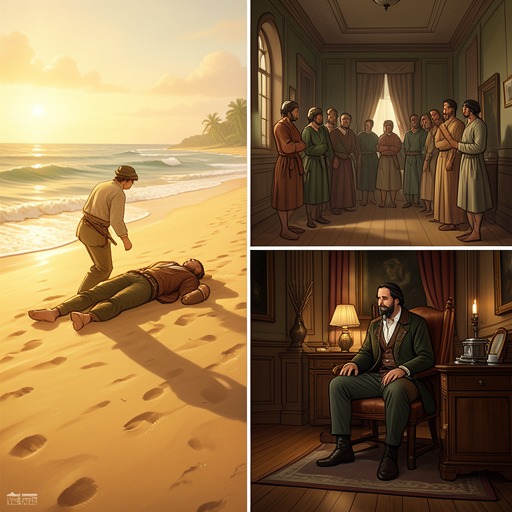
The physical conditions soon become exact and unavoidable. Meursault is later isolated in a cell containing a plank bed hinged to the wall, a latrine bucket, and a tin basin. Through the small window he can glimpse the sea, a view that preserves the existence of the outside world without restoring access to it. The contrast between visible freedom and unavailable freedom becomes central to his imprisonment: sunlight still reaches him, waves still move beyond the prison, but neither can be entered or possessed.
His first visit from Marie briefly interrupts this isolation. The Visitors’ Room is divided by high iron grilles, with a gap of roughly thirty feet separating prisoners from their friends. Marie stands opposite him in her striped dress, surrounded by other visitors, while Meursault must raise his voice across the distance and the noise. When she leaves, she throws him a kiss, but her face remains pressed to the rails in a tense, twisted smile. Soon afterward, her letter informs him that she will no longer be allowed to visit because she is not his wife. That letter produces the decisive psychological change: the cell becomes his last home, a dead end rather than a temporary interruption.
The Prison as a System of Punishment
The jailer explains the governing principle of imprisonment with unusual directness: liberty means being able to act freely, and Meursault is being deprived of it. Meursault recognizes that without this deprivation prison would not constitute punishment. The exchange turns an abstract legal concept into a bodily fact. The walls, routines, and prohibitions do not simply surround him; they make the sentence tangible by replacing choice with regulated repetition.
The prohibition against smoking demonstrates how punishment operates through minor privations as well as through confinement itself. On entering prison, Meursault loses his belt, shoelaces, pocket contents, and cigarettes. After receiving a cell of his own, he asks for the cigarettes to be returned, but is told that smoking is forbidden. The deprivation affects him severely during the first days: he feels faint and bilious and even tears splinters from the plank bed to suck them. The ban initially seems irrational because smoking, in his view, would harm no one. Later he understands that its purpose is precisely to add another controlled loss to his punishment. By then the craving has disappeared, revealing the institution’s power to make its own privations unnecessary through habituation.
The prison also regulates contact and movement. Meursault waits for the daily walk in the courtyard or for a visit from his lawyer, while Marie’s exclusion removes the intimate future he had once imagined. The legal process continues to operate through the prison, where examinations last eleven months and the magistrate’s intermittent friendliness exists alongside the return to jailers. Even moments of apparent social warmth therefore remain enclosed within the machinery of custody.
Adaptation, Memory, and the Collapse of Time
Meursault’s first major struggle is with the persistence of free-man’s thoughts. He suddenly longs to go to the beach, imagines the ripples at his feet, the smooth pressure of water against his body, and the relief of swimming. Such memories do not console him; they sharpen the narrowness of the cell by making freedom sensuously present and physically impossible. The prison is most painful when the mind continues to move beyond it.
This phase lasts only a few months. Meursault gradually acquires what he calls prisoner’s thoughts and learns to organize life around the limited events still available to him. He discovers that, if necessary, he could become accustomed even to living in the trunk of a dead tree while watching a patch of sky. In prison he watches for birds and clouds as he once watched for his lawyer’s unusual neckties, and he waits for Sunday as an opportunity for intimacy with Marie. The comparison shows both the flattening power of confinement and the adaptability of perception: radically different experiences can become equivalent once they are reduced to objects of patient expectation.
Memory becomes his principal form of movement. He reconstructs his former bedroom from a corner, naming each piece of furniture, every object upon or inside it, and then the smallest details of each object: a dent, an incrustation, a chipped edge, the grain and color of the wood. At first the inventory lasts only a minute or two; after repeated attempts, it expands into hours. Prison thus turns recollection into a disciplined exercise. The cell cannot be enlarged physically, but his mental inventory gives it an apparently inexhaustible interior.
Reading also supplies a substitute world. Beneath his straw mattress Meursault finds a yellow, nearly transparent scrap of newspaper describing a crime in a village in Czechoslovakia. A traveler who has made a fortune abroad returns after twenty-five years, books a room under an assumed name at his mother and sister’s hotel, and is murdered by them for his money before his identity is discovered. His mother hangs herself and his sister throws herself into a well. Meursault reads the fragment thousands of times, finding it both improbable and plausible. Like his own imprisonment, the story becomes a fixed object through which repetition changes the experience of time.
Time in prison is simultaneously extended and compressed. Days are long as periods to be endured yet so stretched that they overlap. After six months, a jailer tells Meursault how long he has been confined, but the statement has little mental force; his experience resembles one continuous day in which he repeats the same actions. The altered calendar undermines the ordinary distinctions between past, present, and future, leaving only “yesterday” and “tomorrow” with residual meaning. At the prison’s “nameless hour,” while studying his serious reflection in a tin pannikin, Meursault hears his own voice and realizes that he has been talking to himself. Isolation has become not only spatial but internal.
From Custody to Death Row
As another summer approaches, Meursault learns that his case is scheduled for the final sessions of the Assize Court in June. The prison’s earlier indefinite duration therefore gives way to a more concentrated form of confinement: the sentence of death. When the judgment is pronounced, the court declares that, in the name of the French people, he is to be decapitated in a public place. He hears the formula in a state of near mental suspension and answers “No” when asked whether he has anything more to say. The institution converts a legal decision into an approaching physical event.
After the verdict, Meursault is moved to another cell where he can see the sky and little else. His attention turns to the possibility of a loophole in what he calls the implacable machinery of justice. He imagines condemned prisoners escaping at the last moment, breaking through a police cordon, or vanishing before the guillotine falls. Even a failed escape, ending in a bullet in the back, would offer the gambler’s final throw and a moment of hope. Yet he recognizes that this possibility has been denied to him: he is caught irrevocably in the trap.
The legal verdict seems arbitrary when viewed as a human act. Its force appears diminished by the hour at which it is read, the possibility that it might have been different, and the ordinary physical lives of the men who pronounce it. The phrase “the French people” also strikes him as an abstraction. Nevertheless, once delivered, the judgment becomes as solid and immediate as the wall against which he lies. Imprisonment reaches its final form here: the state’s decision is no longer merely a restriction of movement but an unalterable schedule imposed upon the body.
Death Anxiety and Final Transformation
Death row reorganizes every night around the expectation of dawn. Meursault knows that condemned prisoners are collected at daybreak, so he sleeps intermittently during the day and stays awake through the night, listening for footsteps. The vague hour before morning is the worst because the unseen approach of the jailers makes anticipation more terrible than any visible action. Each morning without footsteps grants him another twenty-four hours, while the smallest rustle sends him to the door, ear pressed against the wood, listening to his own breath.
During the day he reasons through the possibility that his appeal will be dismissed. If he dies at thirty rather than seventy, the world will continue, and death must eventually be endured by everyone. The argument offers a broad equality, but it does not fully console him; the years still available to him make the sentence painful. He therefore permits himself to imagine the appeal succeeding only after first confronting its failure. The sudden joy of that alternative rises through his body and brings tears to his eyes, but he must discipline even hope in order to preserve the order of his thoughts.
His final confrontation with the prison chaplain breaks the remaining structure of imposed consolation. Meursault refuses the chaplain three times, then violently rejects the attempt to make his death intelligible through religious belief. After the chaplain leaves, Meursault sleeps beneath the stars and wakes to the cool air of the summer night, the smells of earth and salt, and the distant siren of a steamer. The world is already carrying other people toward voyages that no longer concern him.
In that stillness, imprisonment yields its final insight. Meursault understands why his mother, near death in the Home for Aged Persons, had taken on a fiancé and played at beginning again: approaching death may make a person feel poised for freedom rather than simply deprived of life. He recognizes the same possibility in himself. The anger released by the confrontation has emptied him of hope, but it also leaves him open to what he experiences as the universe’s “benign indifference.” His imprisonment has not rescued him from death; instead, it has brought him to an acceptance that life and death belong to the same indifferent order. He feels that he has been happy and remains happy, and his last desire is for a huge crowd to greet his execution with howls of execration. Confinement ends not in restored freedom but in a transformed relation to inevitability.